Most families plan to save whatever is left at month end, and nothing is ever left. The fix is to change the order, not to earn more. This article gives simple, tested methods for salaried families, shopkeepers and homemakers, and ends with a 30-day plan you can start this week.
Key takeaways
- Save first and spend what remains. Even 5% of income is a good start.
- Automate saving with an auto-debit to an RD, or a SIP through UPI AutoPay.
- Mutual funds carry market risk, and returns are not guaranteed.
- Adapt the 50/30/20 rule to your rent, loan instalments and family needs.
It is the first of the month. The salary arrives, the rent and bills go out, and by the 20th the account is nearly empty again. Next month the family decides to "save whatever is left", and once again nothing is left. This is the most common story about money, and it has a simple cause: saving was placed last in the line.
The good news is that saving is a habit, and habits can be built in small steps. This article gives practical methods that work for salaried families, shopkeepers, gig workers and homemakers, ending with a 30-day starter plan you can begin this week.
1. Pay yourself first
The single most useful rule is to save first and spend what remains, instead of the other way round.
- On the day the salary arrives, or when the day's cash is counted, move your saving amount out before anything else.
- Treat it like a bill that must be paid, such as electricity or rent.
- Start with whatever amount does not hurt, even 5% of income.
If you wait until the end of the month, other spending will usually have used up the money.
2. Automate it
Willpower runs out; machines do not. The easiest way to save is to make it happen without a decision each month.
- Set up a standing instruction or auto-debit from your salary account to a recurring deposit (RD), at a bank or at the post office.
- If you invest in mutual funds, a SIP (systematic investment plan) can be set up through UPI AutoPay or a bank mandate for a fixed date every month. A SIP is just an automatic monthly instalment into a fund. Mutual funds carry market risk and returns are not guaranteed.
- Pick a date just after your income arrives, not at month-end.
Digital payments have made spending a single tap, as the National Payments Corporation of India reported about 25.47 billion UPI transactions in October 2026. Saving has to be just as effortless, and automation does that.
3. A 50/30/20 plan, adapted for India
The classic rule says: 50% of income for needs, 30% for wants, 20% for saving. It is a good guide, but Indian households often have rent, loan instalments, dependents and festivals, so a flexible version works better. This is a rule of thumb, not an official formula.
| Part of income | Classic rule | Flexible plan for many Indian families |
|---|---|---|
| Needs (food, rent, bills, fees, EMIs) | 50% | 50% to 60% |
| Wants and family or social spending (outings, gifts, festivals, support to relatives) | 30% | 20% to 30% |
| Saving | 20% | 10% to 20% |
If 10% looks impossible, begin at 5% and increase by 1% every few months. Example for a monthly income of Rs 30,000:
| Part | Share | Amount |
|---|---|---|
| Needs | 55% | Rs 16,500 |
| Wants, festivals and family | 25% | Rs 7,500 |
| Saving | 20% | Rs 6,000 |
The total is Rs 30,000. If that saving feels too high, a 10% start gives Rs 3,000 a month, and the extra Rs 3,000 can go to needs or wants for now.
4. Track where the money goes
You cannot fix what you cannot see. Tracking does not need a special app; a notebook works.
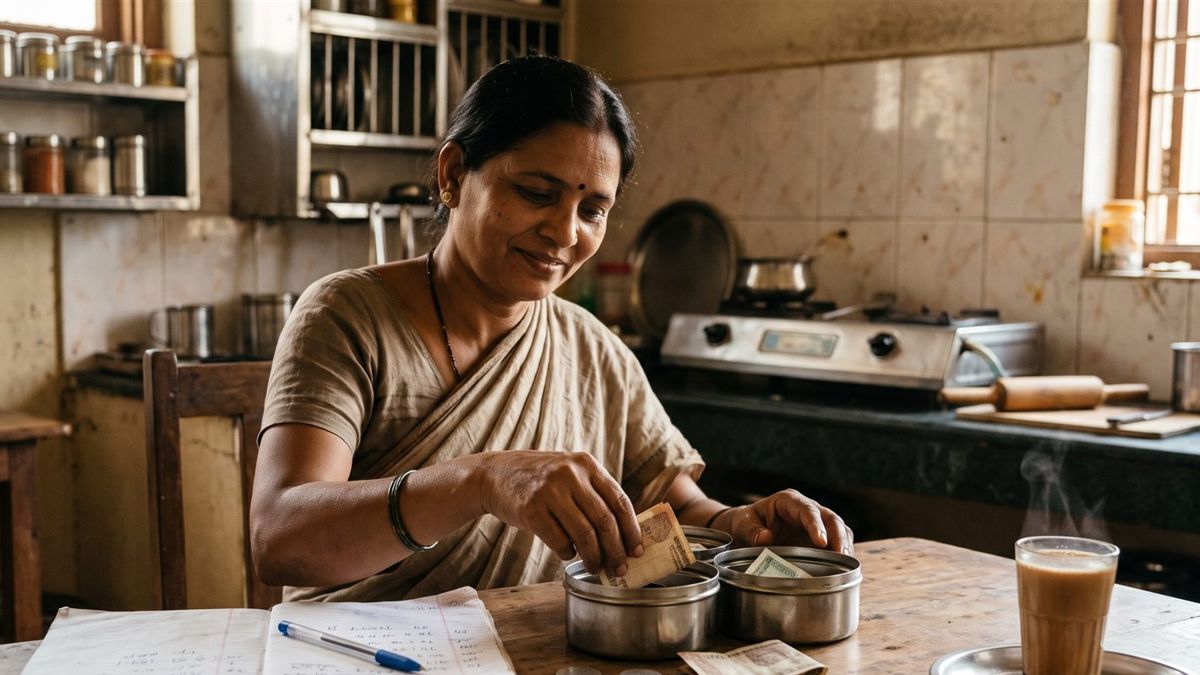
- Keep a 30-day diary. Write every spend, even tea and snacks.
- Review your UPI and bank statement once a month.
- Sort each spend into needs, wants and leaks (spending you did not enjoy or did not notice).
- Do a 10-minute weekly check every Sunday and see whether you are on track.
Most people find a few leaks in the first month. That is not a failure; it is the first saving.
5. Build an emergency fund first
An emergency fund is money meant for urgent needs only, such as a medical bill, a job loss or a vehicle breakdown.
- How big: about 3 to 6 months of your essential expenses (food, rent, bills, instalments, fees). Aim for 6 months or more if your income is irregular or you are the only earner.
- Where to keep it: somewhere safe and quickly available, such as a savings account, a short deposit or a low-risk liquid fund. Safety and easy access matter more than return. Do not keep it in locked or risky products.
- How to build it in stages: Rs 10,000 first, then one month of expenses, then three months.
Example: if your essential expenses are Rs 20,000 a month, three months means Rs 60,000 and six months means Rs 1,20,000. If you save Rs 5,000 a month, the three-month target of Rs 60,000 is reached in 12 months.
Health insurance and term life cover are separate protections. They are not part of the emergency fund. Deposits in a bank are covered by deposit insurance up to Rs 5 lakh per depositor per bank, as of November 2026; check the DICGC website for any change.
6. Sinking funds: save for known big expenses
A sinking fund is money set aside every month for an expense you already know is coming. It turns a big shock into small monthly amounts.
The formula is easy: target amount divided by the number of months left.
| Goal | Target | Months | Set aside each month |
|---|---|---|---|
| School fees, uniform and books | Rs 60,000 | 10 | Rs 6,000 |
| Diwali shopping and gifts | Rs 24,000 | 12 | Rs 2,000 |
| Yearly insurance premium | Rs 12,000 | 12 | Rs 1,000 |
| Wedding in the family | Rs 3,00,000 | 60 | Rs 5,000 |
The wedding row ignores interest, so the real monthly amount could be a little lower if the money earns interest. Keep each goal in a separate recurring deposit or a separate account so that it does not get mixed with daily money. Other candidates for sinking funds are vehicle repairs, festival travel and annual fees. For these, a registered bank or post office recurring deposit is generally safer than an informal committee; our article on where to save explains the difference.
7. Cut the leaks, not the joy
A "leak" is spending that gives little in return. Look for:
- Subscriptions and OTT plans you do not use.
- Delivery charges and impulse online shopping, especially during sales.
- Daily small habits such as tobacco, chewing tobacco or extra snacks, which add up to a large amount over a year.
- Bank charges, late fees and penalties for missed bills.
- Credit card balances carried forward. Interest on unpaid card dues is usually very high, so clearing them is itself a strong saving.
- Buy-now-pay-later and easy-instalment offers that turn small wants into long commitments.
- Mobile recharge plans bigger than your needs, and electricity wasted by idle fans and lights.
Do not try to cut everything at once. Pick the three biggest leaks and fix those first.
8. If your income is irregular
Shopkeepers, daily-wage workers, drivers, delivery partners and gig workers cannot rely on a fixed monthly amount. These methods are built for you:
- Save a percentage, not a fixed sum. Put aside 5% to 10% of every day's sales or every payout. On a day with Rs 2,000 sales, 5% to 10% is Rs 100 to Rs 200.
- Separate business and household money. Keep two accounts. Pay yourself a fixed "salary" from the business to the household account.
- Keep a bigger cushion. Aim for 6 months or more of household expenses.
- Use good months to fill the buffer. When a month is strong, put the extra in the emergency fund first.
- Set aside tax money. Traders who collect GST or need to pay advance tax should keep that money in its own account so that it is not spent.
- Use small steps. A Public Provident Fund (PPF) account can be started with as little as Rs 500 a year under long-standing rules; confirm details at the India Post website.
9. Saving with children and the family
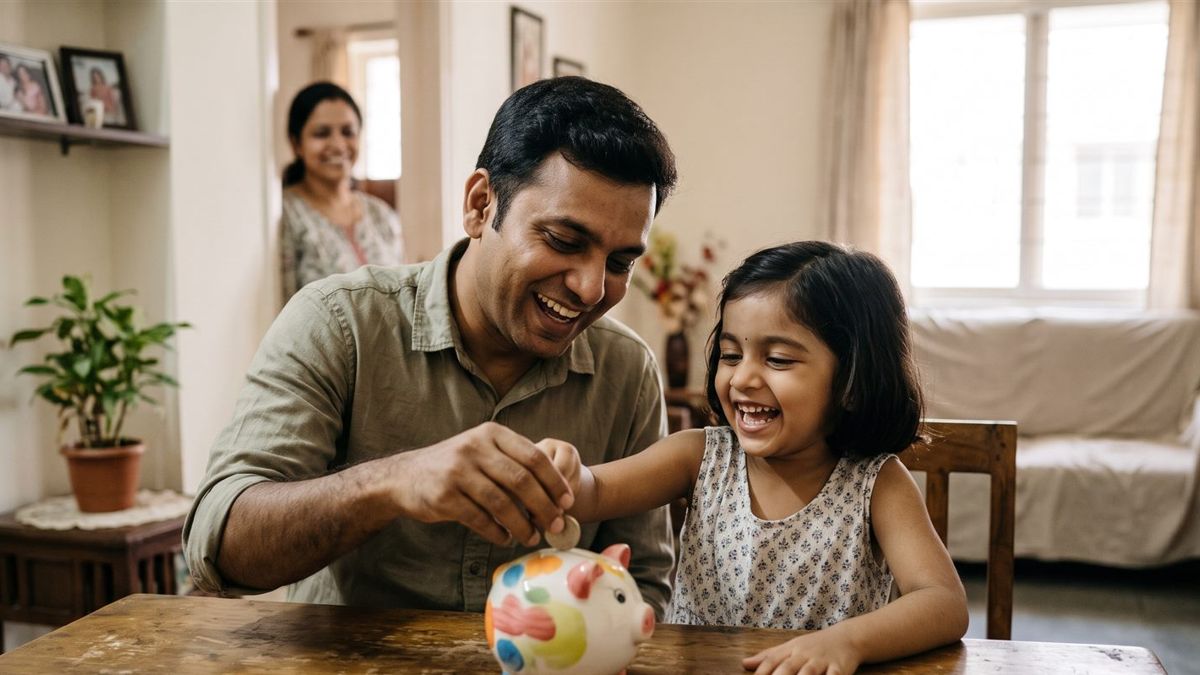
- Pocket-money jar. Give each child a jar or piggy bank and let them watch it grow.
- A bank account in the child's name. Banks offer accounts for minors; ask your branch about the process.
- A girl child's future. The Sukanya Samriddhi Account is a post office and bank scheme for girls; details are in our article on where to save.
- Family money meeting. Spend 20 minutes together every month. Look at income, spending and goals. Involve your spouse, and even older children.
- Needs versus wants. Teach children to ask "do I need this or want this?" before buying.
- Shared goal chart. A chart on the wall showing "Diwali fund" or "new fridge" keeps everyone motivated.
10. Common mistakes to avoid
- Saving only what is left over.
- Having no emergency fund and putting everything into risky investments.
- Mixing insurance with investment. Insurance is for protection; ask a licensed advisor before buying a policy for returns.
- Chasing "double your money" schemes, forwarded tips and anything promising guaranteed high returns. Never share an OTP or PIN.
- Keeping all savings in cash or in a single asset such as gold.
- Breaking a fixed deposit or recurring deposit early and paying a penalty.
- Ignoring inflation. With retail inflation at about 6.09% in October 2026, very low interest quietly reduces buying power.
- Borrowing at high interest for things that are not needed, or taking a loan against savings to pay for a wedding.
- Not adding a nominee or completing KYC on accounts.
A suggested order of steps
- Make a simple budget.
- Build a small starter emergency fund.
- Clear high-interest debt.
- Take basic health insurance and, if others depend on you, term cover.
- Save for goals with sinking funds.
- Then think about long-term investing.
A 30-day starter plan
| Days | What to do |
|---|---|
| Day 1 | Write your monthly income and essential expenses on one page. |
| Day 2 | Open or choose a separate account for savings. |
| Days 3 to 7 | Note down every rupee you spend, including small items. |
| Day 8 | Decide a saving amount, even 5% of income. |
| Day 9 | Set up an automatic transfer for the day after your income arrives. |
| Days 10 to 14 | Keep tracking; mark every leak you notice. |
| Day 15 | Review your first two weeks. Pick the 3 biggest leaks. |
| Days 16 to 18 | Cancel unused subscriptions and fix at least one leak. |
| Day 19 | Write down your top three goals with amount and date. |
| Day 20 | Work out the monthly amount for each goal (target divided by months). |
| Day 21 | Set your first target for the emergency fund: Rs 10,000 or one month of expenses. |
| Days 22 to 25 | Hold a family money meeting and share the plan. |
| Day 26 | List upcoming big expenses for the next 12 months (festivals, fees, premiums). |
| Day 27 | Check that all your accounts have a nominee and complete KYC. |
| Day 28 | Review the month: how much did you save, and what surprised you? |
| Day 29 | Increase the saving amount by 1% or a small round number. |
| Day 30 | Celebrate in a small, low-cost way and plan the next month. |
Key takeaways
- Pay yourself first: move the saving before you spend.
- Automate it so that saving does not depend on willpower.
- Adapt 50/30/20 to your life: 10% to 20% saving is a fine target, and 5% is a fine start.
- Build 3 to 6 months of essential expenses as an emergency fund, and more if your income is irregular.
- Use sinking funds for festivals, school fees and weddings, by dividing the target by the number of months.
- Irregular earners should save a percentage of each day's or week's income.
FAQ
How much should I save each month?
A common starting point is 10% to 20% of income. If that is hard, start with 5% and raise it gradually.
What is an emergency fund and how big should it be?
It is money for urgent needs only. Aim for 3 to 6 months of essential expenses, and more if your income is irregular.
Where should I keep the emergency fund?
Somewhere safe and quickly available: a savings account, a short deposit or a liquid fund. Not in locked or risky products.
Is the Rs 5 lakh bank deposit insurance limit per account or per bank?
It is per depositor, per bank, across accounts held in the same capacity. As of November 2026 it is Rs 5 lakh; a rise was reported as under discussion but is not confirmed.
What if I miss a month?
Do not give up. Restart next month at a smaller amount. A habit is built by returning, not by being perfect.
Should I invest before building an emergency fund?
Generally, build at least a starter emergency fund first, so that you do not have to sell investments at a bad time.
Disclaimer: We are not an insurance advisor, financial advisor, tax advisor or lender. This article only shares general information and is not advice. Rates, rules and limits change, so please check the official website of the bank, insurer, RBI, IRDAI or the Income Tax Department, or speak to a licensed professional, before you decide.
More articles
Vehicle Loan in India: A Complete Guide for Two-Wheelers and Cars (New and Used)
Planning to buy a bike or a car on loan? Learn how vehicle loans work in India, what they really cost, which documents you need and how to avoid costly traps.
Read →Vehicle Insurance in India: Types, Benefits, IDV, NCB, Claims and What Every Buyer Should Know
Third-party or comprehensive? What is IDV, and why does a claim-free year cut your premium? A plain-language guide to motor insurance for car, bike and scooter owners.
Read →Shop and Stock Insurance for Small Shopkeepers in India: A Practical Guide
Fire, burglary, shopkeeper's package and other covers explained for small shops, with a worked under-insurance example, documents to keep and claim steps.
Read →Life Insurance in India: Plan Types, Claims, Tax and How to Choose
Term, whole life, endowment, ULIP, pension plans and government schemes explained in plain words, with claim steps, rejection reasons, tax rules and a grievance route.
Read →Home Loan in India: A Complete Guide to Rates, Documents, EMI and Tax Benefits
A plain-language guide to taking a home loan in India: interest rate range, charges, documents, EMI maths, prepayment, tax benefits and mistakes to avoid.
Read →Gold Loan in India: Rules, Rates, Documents and How to Borrow Safely
A gold loan can give quick cash against your jewellery, but the rules, rates and auction risk matter. Here is a clear guide based on the RBI's gold loan directions.
Read →This article is general information, not professional advice for your specific case. Rules change, so please confirm on the official portal.