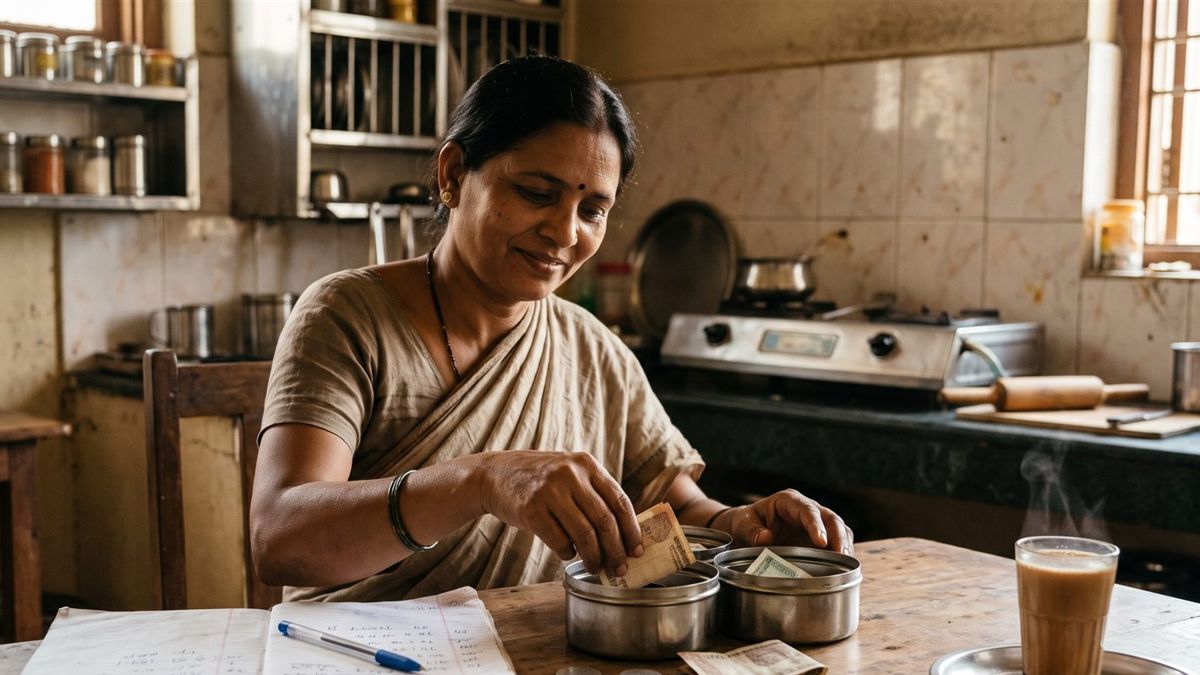

When a sudden bill arrives at month end, many families find they have only a few hundred rupees left. This is rarely about bad character. It usually means nothing was set aside first. This article explains what saving is, how it differs from investing and what it gives your family over time.
Key takeaways
- Saving is income minus spending. The part you keep aside is your saving.
- Saving means safe and available money. Investing means growth with some risk.
- An emergency fund helps you pay a sudden bill from your own money.
- Saving comes first, and investing comes second.
The month ends, the salary or the daily takings have gone, and a sudden bill arrives: a hospital visit, a broken scooter, a child's school fee. The family looks at the account and finds only a few hundred rupees. Many households in India know this feeling well. It is not a sign of laziness or bad character. It is usually a sign that nothing was set aside before the money was spent.
This article explains, in plain words, what saving is, why it matters, what it gives you over time, and why so many families find it hard. We also show a simple table of how small monthly amounts can grow.
What is saving (bachat)?
Saving is simple arithmetic: income minus spending. The part you do not spend, and keep aside for later, is your saving.
It helps to separate two words that are often mixed up:
- Saving means keeping money safe and available. Examples are a savings account, a recurring deposit or a fixed deposit. The aim is safety, not a big return.
- Investing means putting saved money to work so that it can grow, with some risk that it may fall. Examples are mutual funds and shares.
Saving comes first. Investing comes second. A family that has no savings and puts money into risky products can be forced to sell at a loss the moment an emergency arrives.
Why saving matters
Money that comes in is not always steady, and expenses are never steady. Saving is the bridge between the two. Here is what it gives you.
1. Safety in an emergency
A job loss, a slow season in the shop, an illness, or a repair that cannot wait: these things do not send a warning. An emergency fund, meant only for such times, lets you pay the bill from your own money instead of asking others or borrowing.
2. A life with less debt
When there is no cushion, the only way to pay a sudden bill is to borrow, often from a moneylender or by using a credit card. High-cost borrowing can take years to clear. People who save regularly borrow less, and when they do borrow, they borrow for something useful and on their own terms.
3. The ability to say yes to goals
School and college fees, a daughter's wedding, repairs to the house, new stock for the shop, a two-wheeler, a small trip home: all of these cost money at a known time. If you save towards them month by month, you can say yes to the goal without a loan.
4. Dignity and independence
Having money of your own means you do not have to depend on a relative, a neighbour or a lender for every difficulty. Older people in particular value this. Saving during working years is what makes an independent old age possible.
5. Peace of mind
Worry about "what if" is itself costly. It affects sleep, health and decisions. Knowing that a few months of expenses are safely put aside makes family life calmer and lets you think clearly at difficult moments.
6. The power of compounding
This is the quiet benefit that grows with time. When your saving earns interest, and then that interest also starts earning interest, the amount grows faster each year. The longer you wait, the more you give up, so starting early, even with a small amount, matters more than starting big.
A simple compounding table
The numbers below show what a fixed amount saved at the end of every month could become, if it earns the stated yearly return, compounded monthly. These are illustrations, not promises. The 6% row is similar to what many safe deposits aim to pay. The 12% row is an assumption of the kind sometimes used for equity-linked investments; it is not guaranteed and real results can be much lower or even negative in some years. Tax and inflation are ignored.
| Monthly saving | Yearly return | After 10 years | After 20 years |
|---|---|---|---|
| Rs 1,000 | 6% | Rs 1,63,879 | Rs 4,62,041 |
| Rs 1,000 | 12% | Rs 2,30,039 | Rs 9,89,255 |
| Rs 2,000 | 6% | Rs 3,27,759 | Rs 9,24,082 |
| Rs 2,000 | 12% | Rs 4,60,077 | Rs 19,78,511 |
| Rs 5,000 | 6% | Rs 8,19,397 | Rs 23,10,204 |
| Rs 5,000 | 12% | Rs 11,50,193 | Rs 49,46,277 |
The amounts you actually put in are smaller than these totals:
| Monthly saving | You deposit in 10 years | You deposit in 20 years |
|---|---|---|
| Rs 1,000 | Rs 1,20,000 | Rs 2,40,000 |
| Rs 2,000 | Rs 2,40,000 | Rs 4,80,000 |
| Rs 5,000 | Rs 6,00,000 | Rs 12,00,000 |
How to read it: if you save Rs 1,000 every month for 20 years and it earns 6%, you deposit Rs 2,40,000 and end up with about Rs 4,62,041. The extra Rs 2,22,041 comes from interest on interest. At Rs 5,000 a month for 20 years at 6%, you deposit Rs 12,00,000 and reach about Rs 23,10,204.
Notice also that doubling the time does far more than doubling the amount. At 6%, Rs 1,000 a month grows to Rs 1,63,879 in 10 years but to Rs 4,62,041 in 20 years, which is almost three times as much for twice the time. That is compounding at work. Bank recurring deposits compound quarterly, so real maturity amounts will differ slightly from this table.
Inflation: the reason "just keeping it" is not enough
Prices rise over time, so the same rupee buys less each year. As per the Ministry of Statistics' release for October 2026, retail inflation (the Consumer Price Index) was about 6.09% (provisional), and food inflation was about 8.94%. You can see the latest numbers on the Ministry of Statistics website.
Here is what this means for your money. Suppose Rs 1,00,000 sits in a savings account paying 4% while prices rise 6% in a year:
- After one year the account shows Rs 1,04,000.
- The same basket of goods that cost Rs 1,00,000 now costs about Rs 1,06,000.
- So your money has become about Rs 2,000 poorer in buying power, even though the balance went up.
The gap between interest earned and inflation is called the real return. When it is negative, your savings quietly lose value. This is why money kept for years in cash or in a very low-interest account does not protect you. Money for emergencies must be kept easy to reach, but money for goals that are several years away should earn something closer to, or above, the inflation rate. We list the common options in a separate article on where Indians can save and invest.
Why many Indian families find saving hard
Understanding the reasons removes the guilt and helps in finding fixes.
1. Saving "what is left" usually means saving nothing. Spending expands to fill the income. If saving is the last step, there is usually nothing left to save.
2. Festivals, weddings and social pressure. Diwali, Eid, Raksha Bandhan, weddings and family functions are loved and expected. Gifts, clothes, sweets, travel and a function that looks good to the community can add up to several months of savings. Weddings are sometimes paid for with loans that take years to repay. Planning for them in advance, rather than spending on the spot, is the answer, not giving up the joy.
3. Rising prices, especially food. When food costs rise faster than income, families cut saving first because it feels optional.
4. Irregular income. Shopkeepers, daily-wage workers, drivers and gig workers do not know what next week will bring. A fixed monthly saving feels impossible, so they save nothing at all.
5. Large family responsibilities. Supporting parents, siblings or relatives is a loving duty in many homes, and it leaves little room unless it is planned for.
6. Easy spending. Digital payments have made spending effortless. The National Payments Corporation of India reported about 25.47 billion UPI transactions in October 2026, worth about Rs 31.53 lakh crore. When paying takes one tap, small spends pass unnoticed. Saving has to be made equally easy, which means automatic.
7. Fear and distrust. After hearing of frauds, many people prefer cash, gold or informal committees, and fear that putting money in a bank or a fund means "locking it up". Some of these fears are fair, but cash at home earns nothing and can be lost, stolen or spent.
8. Limited financial knowledge. The National Centre for Financial Education's survey for 2018-19 found that only about one in four adults was financially literate by its measure. We did not find a newer national figure. This is a gap in teaching, not in intelligence.
Small first steps that work
You do not need a big income to start. These are the first steps, and the next article, on how to build the saving habit, covers them in detail.
- Start tiny. Even Rs 100 a week, or 5% of income, creates the habit.
- Move the money first. Transfer the saving on salary day or when the day's sales are in, before spending.
- Keep it separate. Use a different account so that it is not part of your daily balance.
- Name the goal. "School fees in June" or "Rs 60,000 emergency fund" is easier to protect than "savings".
- Raise it slowly. Increase the amount by a little every few months.
Key takeaways
- Saving is income minus spending; it is the base on which every other money goal stands.
- It protects you in emergencies, lowers debt, funds goals and gives dignity and peace of mind.
- Compounding rewards time: doubling the years can nearly triple the result, as the table shows.
- With retail inflation near 6% in October 2026, money kept at very low interest slowly loses buying power.
- Saving is hard because of behaviour, festivals, weddings, irregular income and easy spending, not because of a lack of character.
- Start small, save first and automate; a habit matters more than the amount.
FAQ
How much should I save each month?
A common starting point is 10% to 20% of income. If that feels too hard, start with 5% and raise it slowly.
Is saving the same as investing?
No. Saving keeps money safe and available. Investing puts money to work for growth and carries some risk. Build savings first.
Does inflation affect my savings?
Yes. With retail inflation at about 6.09% in October 2026, a savings account paying about 4% loses some buying power each year.
Are the compounding figures guaranteed?
No. They are illustrations. Real returns differ, particularly for market-linked products, which can fall in value.
I earn an irregular income. Can I still save?
Yes. Save a percentage of each day's or week's income instead of a fixed amount. Our article on building the saving habit explains how.
What if I can only save a very small amount?
Small is fine. The habit matters more than the amount, and you can increase it later.
Disclaimer: We are not an insurance advisor, financial advisor, tax advisor or lender. This article only shares general information and is not advice. Rates, rules and limits change, so please check the official website of the bank, insurer, RBI, IRDAI or the Income Tax Department, or speak to a licensed professional, before you decide.
More articles
Vehicle Loan in India: A Complete Guide for Two-Wheelers and Cars (New and Used)
Planning to buy a bike or a car on loan? Learn how vehicle loans work in India, what they really cost, which documents you need and how to avoid costly traps.
Read →Vehicle Insurance in India: Types, Benefits, IDV, NCB, Claims and What Every Buyer Should Know
Third-party or comprehensive? What is IDV, and why does a claim-free year cut your premium? A plain-language guide to motor insurance for car, bike and scooter owners.
Read →Shop and Stock Insurance for Small Shopkeepers in India: A Practical Guide
Fire, burglary, shopkeeper's package and other covers explained for small shops, with a worked under-insurance example, documents to keep and claim steps.
Read →Life Insurance in India: Plan Types, Claims, Tax and How to Choose
Term, whole life, endowment, ULIP, pension plans and government schemes explained in plain words, with claim steps, rejection reasons, tax rules and a grievance route.
Read →Home Loan in India: A Complete Guide to Rates, Documents, EMI and Tax Benefits
A plain-language guide to taking a home loan in India: interest rate range, charges, documents, EMI maths, prepayment, tax benefits and mistakes to avoid.
Read →Gold Loan in India: Rules, Rates, Documents and How to Borrow Safely
A gold loan can give quick cash against your jewellery, but the rules, rates and auction risk matter. Here is a clear guide based on the RBI's gold loan directions.
Read →This article is general information, not professional advice for your specific case. Rules change, so please confirm on the official portal.